Coordinated landscape-scale investigations of a Punic City in the Central Mediterranean
Synopsis
Space and Identity is a joint project by Jason Herrmann and Paola Sconzo that works within the University of Palermo Mission to Mozia to examine the urban fabric of ancient Motya with landscape archaeology methods. Space and Identity has been made possible with support from the Gerda Henkel Stiftung, ASOR, the International Society of Archaeological Prospection, and the Penn Museum.
Description
Since 2017, the Space and Identity project has included multi-sensor geophysical survey, controlled surface collection, and test excavations to verify Isserlin’s observations and to intensively map the ancient built environment across the island site. Our results comprise the largest ‘exposure’ of domestic structures and urban space in the Punic world and reveal new dimensions of life within a Punic city during the 6th and 5th centuries BCE.
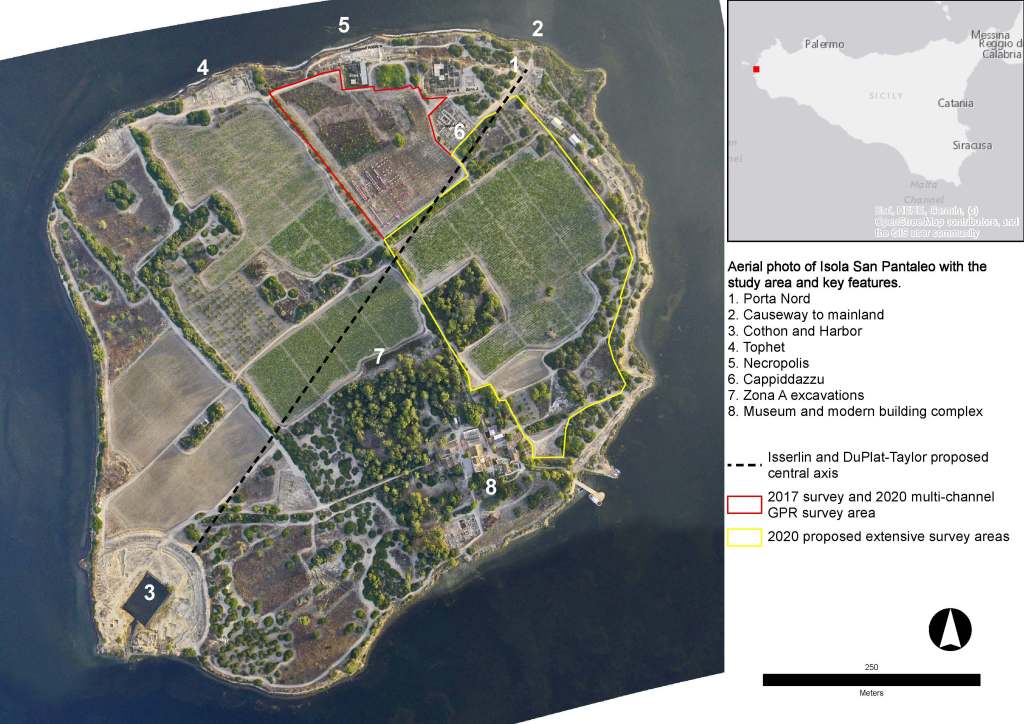
Our results show that buildings at Motya were set on an extensive orthogonal plan that formed the spatial framework for densely packed segmented buildings. Consistency in the shapes, sizes, and orientations of structures demonstrate that there was a coordinated effort in designing these 6th century BC spaces. Such a gridded plan was once thought of as a Greek innovation, but is now better understood as evidence for a schema for top-down settlement planning shared by people across the Mediterranean during the first half of the first millennium BCE and regularly employed in Phoenician and Punic settlements.
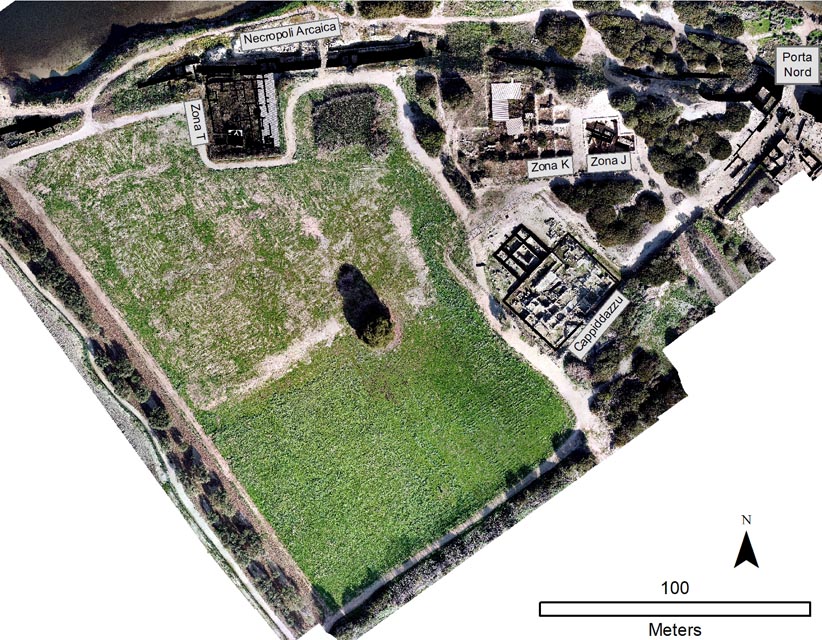
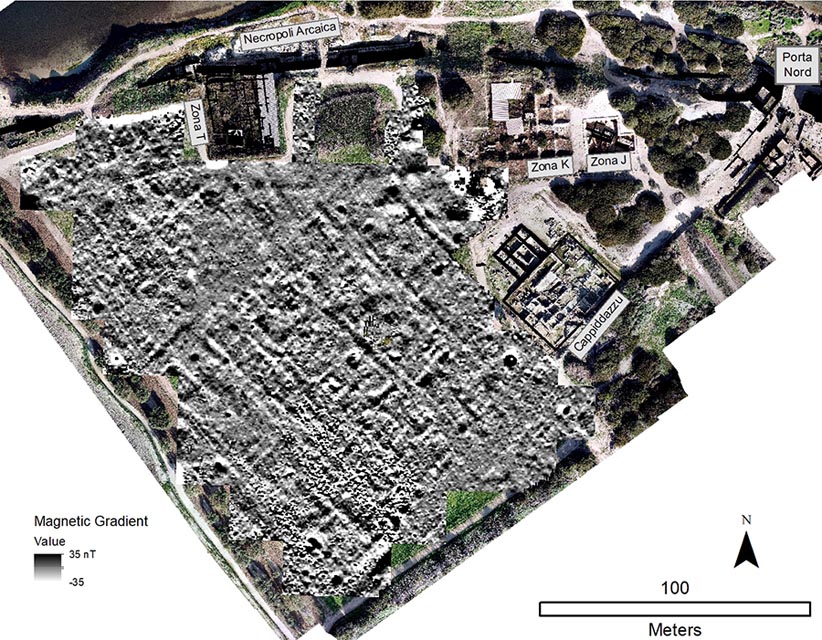
Left: orthomosaic of the NW quadrant of Isola San Pantaleo. Right: magnetic gradiometry results. After Herrmann and Sconzo 2000.
A closer look at the geophysical survey results shows that individual elements of these segmented buildings were constructed independently but conformed to a standard size. This evidence, taken with data from excavations of similar contexts on site and elsewhere, parallel studies on ceramic forms, the diversity of ritual iconography, and analysis of genetic material from Motya and contemporary Punic sites, reinforces the idea Motya’s population was comprised of people from a variety of geographic origins and ethnic backgrounds and suggests that there were substantial bottom-up influences on the urban fabric.
These two forces on the organization of space, one from a managing authority and the other from the household or individual level, has led us to hypothesize that this pattern of urban planning is part of a system by which newcomers were integrated into colonial Punic life. Were these houses built by and for North African colonists brought to Sicily for political purposes? Was it an allotment system for new urban settlers from across the Mediterranean? Or part of a system to bring local people from the hinterland into Punic urban spaces? Our ongoing research in this domestic quarter of the site is designed to test these very questions, beginning with the basics: When and how was this neighborhood established and how were people organized within it? Who were the occupants? What roles did these people play in Motyan society? The answers to these questions will not only tell us who was living in these quarters, but engage the wider conversation about the Phoenicio-Punic identities and colonialism.
At the core of our research are the questions: What can the archaeological record tell us about how the use of space was negotiated between the settlement’s architects and its occupants? And what does that tell us about identity at multiple scales: both of the citizens of Motya and of a possible broader Punic identity? Our hope is that our results will bring us closer to understanding how the built environment of settled spaces reflects the identities of urban residents in the Phoenician and Punic world, and help us to move beyond the dichotomy of colonizer and colonized.
Peer Review Articles
Herrmann, Jason T., Paola Sconzo and Leonarda Fazio. 2023. Refining Motya’s Urban History with Landscape-Scale Investigations. Rivista di Studi Fenici. 51: 73-107. https://doi.org/10.19282/rsf.51.2023.03
Herrmann, Jason T. and Paola Sconzo. 2020. Planning Punic Cities: Geophysical prospection and the built environment at Motya, Sicily. Antiquity. https://doi.org/10.15184/aqy.2020.97.
Other Publications
Herrmann, Jason T. 2025. Mapping Motya from Above and Below. Expedition. Vol 66(3) 40-49.
Herrmann, Jason T. 2022. In the Labs: The New CAAM Digital Laboratory. Expedition Vol 65(1) 40-41.
Herrmann, Jason T. and Jackson Clark. 2021. Return to the Field: Mapping the Urban Plan of Ancient Motya. Expedition. Vol 62(3) 18-21.
Hermann, Jason T. 2020. In the Labs: Teaching Geophysical Survey. Expedition. Vol. 62(2) 56-57.
Conference Presentations
Sconzo, Paola and Jason T. Herrmann. Mozia, una Città Punica Svelata: archeologia e geofisica per lo studio dell’urbanistica antica. Motya, A Punic City Revealed. 2025. With Paola Sconzo. Public workshop, roundtable and tours at Mozia, Italy.
Herrmann, Jason T. and Paola Sconzo. 2025. Building Space, Identity and a Home for Motyans. Archaeological Institute of America Meeting. Philadelphia, USA.
Herrmann, Jason T. and Sconzo, Paola. 2024. Archaeogeophysics and Ancient Motya’s Arrivals, Administration, and Ancestors. European Archaeology Association Meeting (EAA). Rome, Italy.
Sconzo, Paola. Mozia isola plurale. 2023. Riflessioni sull’esperienza e le ricerche dell’ultimo decennio della Missione dell’Università di Palermo. Conference “Isole mediterranee. Storie, culture, patrimoni dedicato a Sebastiano Tusa”. Favignana, May 18-19 2023.
Herrmann, Jason T. and Sconzo, Paola. 2022. Landscape Scale Investigations at Motya. Tenth International Congress on Phoenician and Punic Studies. Ibiza, Spain.
Herrmann, Jason T. and Sconzo, Paola. 2018. Impressions of the Urban Organization of Motya as Revealed through Remote Sensing. International Congress of Phoenician and Punic Studies. October 22-26, Mérida, Spain.
Public Lectures
Herrmann, Jason T. 2025. The Shape of Punic Cities. Penn Museum Archaeology in Action Lecture Series.
Sconzo, Paola. 2024. Mozia, Crocevia Di Culture: Dal primo insediamento fenicio alla città fortificata: 10 anni di scavi e ricerche dell’Università di Palermo. Invited Lecture delivered at the University of Udine, 20th of May 2024.
Herrmann, Jason T. and Sconzo, Paola. 2024. Spazi urbani e identità culturali nell’antica Mozia. Lecture delivered at the University of Palermo, 28th of Feburary 2024.
Herrmann, Jason T. 2021. How to do archaeology without a shovel: understanding ancient cities with remote sensing. Science on Tap Philadelphia. https://www.scienceontapphilly.com/
Herrmann, Jason T. 2020. Mapping Sites Underground with Digital Archaeology. Penn Museum Living Room Lectures. https://www.penn.museum/events/adult-programs/living-room-lectures
https://www.unipa.it/dipartimenti/cultureesocieta/Missioni-Archeologiche/Missioni-in-Sicilia/Mozia/
Facebook: https://www.facebook.com/MoziaUniPa/
Instagram: https://www.instagram.com/mozia_unipa/
Team
Dr. Jason T. Herrmann, Co-Principal Investigator. Kowalski Family Teaching Specialist for Digital Archaeology, Center for the Analysis of Archaeological Materials (CAAM), Penn Museum and Department of Anthropology, University of Pennsylvania
Dr. Paola Sconzo, Co-Principal Investigator. Professor of Near Eastern and Phoenician-Punic Archaeology, Department of Culture and Society, University of Palermo.
Prof. Gioacchino Falsone, Archaeologist. Retired Professor, Department of Culture and Society, University of Palermo
Sponsors
Gerda Henkel Foundation (awards AZ 26/V/17 & AZ 19/V/20)
Stevan B. Dana Grant, ASOR
International Society for Archaeological Prospection
Whitaker Foundation
Soprintendenza di Trapani
Penn Museum
Price Laboratory for Digital Humanities
Partners and Collaborators
University of Palermo
Penn Museum
University of Tübingen (2017-2019)
 Jason T. Herrmann